 ไทย
ไทย
About HTA Guideline
The Health Technology Assessment Guideline for Thailand (HTA Guideline) is a key resource developed to support evidence-based health decision-making. It compiles standard approaches, methods, and tools for assessing health technologies across clinical, economic, and social dimensions.
Introduction
Health Technology Assessment Guideline for Thailand, 2026 Update. Health Technology Assessment (HTA) is an important tool for Thailand's health policy decision-making, ranging from the selection of medicines for the National List of Essential Medicines to vaccines and various benefit packages. Thailand has developed 3 previous versions of the manual (2008, 2014, and 2023), and the latest has been updated to the 2026 version to keep up with modern health technologies such as precision medicine and genomics, digital health technologies, medical devices, and artificial intelligence (AI), as well as Early HTA, which has never been mentioned in previous editions.
This manual is developed based on Good Practice in HTA Guideline Development in accordance with international standards, through a transparent process with the participation of experts and stakeholders from all sectors across the country. It covers 15 main methodological chapters and 15 special chapters on additional knowledge.
Structure of the Guideline
This guideline consists of 15 main chapters and 15 special chapters, designed to support multiple use cases, whether it is reading for a general understanding, searching for specific recommendations, or applying tools in practical work.
1. Reference Case
The Reference Case is a summary table of the main recommendations from all chapters of the manual, showing the standard guidelines recommended for health technology assessment, allowing users to quickly grasp the overall picture of all guidelines without having to read every detail.
The Reference Case plays a vital role in promoting consistency, transparency, and comparability of study results across different research studies. If there is a need to use approaches different from the Reference Case, researchers should clearly state the reasons and report the relevant analytical results concurrently.
2. Content of each chapter
Each chapter of the manual consists of 3 main parts:
Guideline Statements summarize the recommendations and key substance of the guidelines in each chapter concisely, helping readers quickly capture the main points and understand what should be done.
Guidelines in Detail present the details, rationales, and supporting evidence of the recommendations, including practical guidelines in areas where there is no consensus on academic conclusions, to support decision-making and appropriate application of the guidelines to the context of each study.
Technical Appendices compile tools, calculation examples, standard forms, and technical information specifically related to the content in that chapter to support the practical implementation of the guidelines.
3. Appendices and additional resources
Appendices are shared appendices across the manual, collecting information and resources that can be used to support work across multiple chapters or topics, not limited to any specific chapter.
Examples of content include a glossary shared throughout the book, as well as general guidelines or tools useful for health technology assessment in overview.
The goal is for this manual to serve as a standard reference framework for health research and policy decision-making in the country, available in both print and online (website) formats.

Previous Versions
The HTA Guideline is continuously developed and updated to align with the changing knowledge, technology, and context of the health system.
Authors
The HTA Guideline was developed in collaboration with experts from various fields to ensure that the content is accurate, comprehensive, and practical.

รศ. ดร. วรรณฤดี อิสรานุวัฒน์ชัย
Editor

Supporting organizations
This project is supported by organizations that play a key role in developing Thailand's health system, with the goal of promoting the use of empirical evidence in policymaking and supporting the sustainable development of health technology assessment research.

Contact us
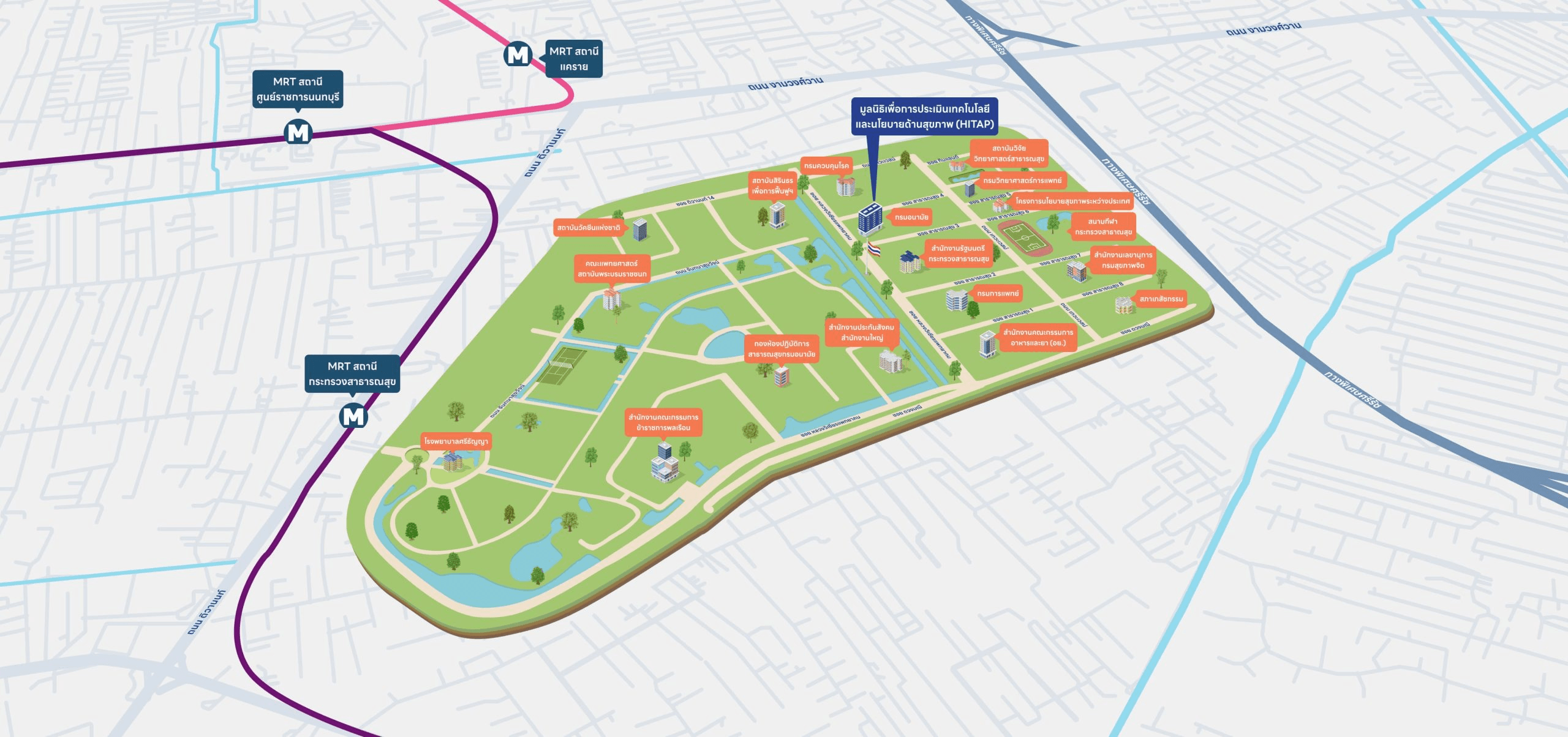
Health Intervention and Technology Assessment Program (HITAP)
Address
Head office: 88/22 Moo 4, Building 6, 6th Floor, Department of Health, Ministry of Public Health, Tiwanon Road, Talat Khwan, Mueang Nonthaburi, Nonthaburi 11000
Phone
(+66) 2-590-4549
Fax
(+66) 2-590-4369
e-Document
letter@hitap.net